


NATA asked AvAdvisors to analyze 2025 activity at the TOP 500 airports measured by FAA aircraft movement data and comment on industry trends. Since the pre-COVID baseline year of 2019, activity has benefited from a steady migration of air travelers to business aviation options, providing a range of aircraft types and access models, from per-flight charter to full and fractional ownership. The resulting easier access to private air travel, along with time-saving convenience, has captured the market’s attention for business and personal travel like never before. Once experienced, it is difficult to return to the next airline connection, which is why new users tend to stay, or are “sticky” in marketing parlance. The 2020 COVID disruptions created a significant wave of travelers new to our industry.
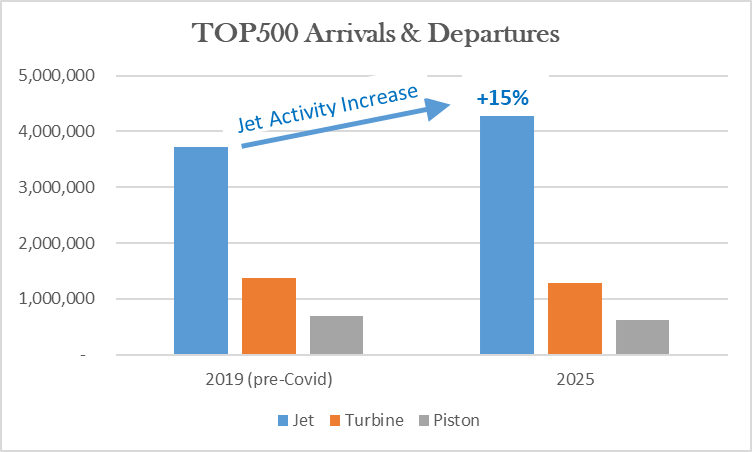
So it follows that in the six years from pre-COVID 2019 to 2025, TOP 500 business aviation activity for all aircraft types grew 7%, led by a 15% increase in jet arrivals and departures, as shown below.
Along with the growth of jet activity, there has also been increasing demand for super-midsize and larger, longer-range aircraft relative to lighter jets. To service the related ground support requirements, FBOs are expanding ramp space, adding hangars, and upgrading terminals and passenger amenities. Major construction is occurring from Bozeman to Birmingham and from Jackson Hole to Palm Springs as FBOs and airports accommodate the increasing number and size of based and transient aircraft.
Take Austin, TX, (AUS), for example. Rising to No. 15 in the 2025 ranking, AUS is served by three FBOs in this growing market. Million Air recently began hangar, office, and ramp construction, doubling the size of its FBO campus, shown below.
The airport-by-airport analyses rank the TOP 500 airports based on 2025 jet activity and also show data and trends for the turbine and piston categories. Airports and FBOs can use the data to track trends and compare activity levels with other airports in a particular region.
The accompanying listing of the TOP 500 airports is intended to serve as a useful resource for planning and benchmarking within your aviation service business.
Methodology Note: The activity data is available at FAA.gov and the TFMSC database for “Airports.” The data is filtered to include “Business Aviation” (this eliminates other activity like airlines and most flight training) and grouped by “Physical Class,” (i.e., Jet, Turbine and Piston).
By Mark Chambers, Managing Partner, avAdvisors
Mark Chambers is Managing Partner of AvAdvisors specializing in
developing and managing transactions involving aviation service businesses for over 20 years. Prior experience includes a progression of senior management positions leading FBO services, Part 145 maintenance and avionics operations, and Part 135 charter and management operations. Mark holds airman ratings up to ATP and has flown 3,600 hours as PIC in both Part 91 and 135 operations, in experimental aircraft, and as a flight instructor. Mr. Chambers soloed on his
16th birthday and began his aviation career in line services. Please send comments or questions to mark@av-advisors.net.